Two announcements in quick succession from Brazil’s foreign trade watchdog, the Executive Management Committee of the Foreign Trade Chamber (GECEX), show that steel products originating in China remain very much under scrutiny by the government in Brasilia.
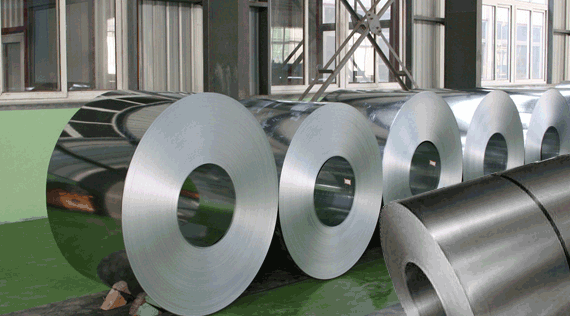
On February 13 according to a notice in the Brazilian government gazette, (GECEX) has accepted a claim of damage from a domestic maker of carbon steel cold-rolled coils and imposed anti-dumping (AD) duties ranging from $322.93 to $641.73/t on China-origin cold-rolled steel for a period of five years, effective from the date of publication.
The products concerned are CR carbon steel flat-rolled products, alloyed or non-alloyed, in sheets or in coils, of any width or thickness, according to the post. They are classified under Mercosur tariff codes 7209.15.00, 7209.16.00, 7209.17.00, 7209.18.00, 7209.25.00, 7209.26.00, 7209.27.00, 7209.28.00, 7209.90.00, 7211.23.00, 7211.29.10, 7211.29.20, 7225.50.90 and 7226.92.00.
The decision stems from complaint against the Chinese CR filed by domestic steelmaker Usina Siderúrgica de Minas Gerais S.A. in April 2024 which led to a dumping investigation being initiated the following August. The investigation period covered January to December 2023, while the injury analysis examined the period from January 2019 to December 2023, Mysteel Global notes.
In March last year, Brazil's Ministry of Development, Industry, Trade and Services, through its Foreign Trade Secretariat (SECEX), issued a preliminary affirmative determination upholding the steelmaker's complaint.
However, as the precise scope of the product under investigation required further clarification, provisional anti-dumping duties were not imposed at that stage while the investigation continued. This culminated in the final ruling being announced this month.
Perhaps not surprisingly, the launch of the probe prompted Chinese shippers to rein in their CR shipping volumes to Brazil. Data from China's General Administration of Customs (GACC) show that exports of Chinese CR flats to Brazil totaled just 271,946 tonnes last year, lower by a whopping 44% from 2024.
Significantly, the announcement emphasized that the AD duty does not apply to semi-processed non-grain-oriented (NGO) electrical steel classified under Mercosur codes 7225.19.00 and 7226.19.00, provided that the products meet certain criteria regarding elements.
This was doubtless because imports of China-origin NGO steel under the same Mercosur tariff codes 7225.19.00 and 7226.19.00 were a focus in a separate AD case where the results of a sunset review were soon to be announced.
Last Monday, CECEX announced that it had concluded a public interest assessment of AD measures on NGO electrical steel imports from China, Taiwan, South Korea, and Germany, with the decision being to raise those on Chinese steel while leaving those on the other three shippers unchanged.
Public interest assessments allow the importing country to decide whether the imposition of anti-dumping measures is in the broader public interest, despite dumping, injury and casual link.
Brazil had initiated an AD investigation into NGO steel from just China, Taiwan and South Korea in April 2012, in response to a petition submitted by local steelmaker Aperam Inox América do Sul S.A. A final affirmative determination was issued in July the following year.
In July 2018, Brazil launched the first sunset review of the measures on imports from the above origins, which concluded in July 2019 with an affirmative determination to maintain the duties. Separately, an AD probe into those from Germany was started in May 2018 and resulted in an affirmative final ruling also in July 2019.
A second sunset review was started in July 2024 with Brazil deciding to extend the ADs on the subject imports for an additional five years, though last August the Brazilian authorities announced the self-initiation of a public interest review of the AD penalties on the four shippers.
This review led Brazil to lift the AD duties on the NGO sheet and coil products from China to $105.55-195.05/tonne, up from the previous level of $90-166.32/t, while the duty levels on imports from the other three targeted countries remain unchanged. Those from South Korea are still subject to levies of $0–166.32/t, those from Taiwan still at $90-166.32/t, and Germany at $166.32/t.
Why the duties only on Chinese NGO flats were raised is unknown. Certainly, China's exports of the products seem to be declining. According to GACC data, China's total electrical steel sheet (strip) exports to Brazil totaled 97,128 tonnes last year, down by 5.6% from the 2024 volume. The GACC does not differentiate between GO and NGO silicon steel exports.
Source:Mysteel Global