
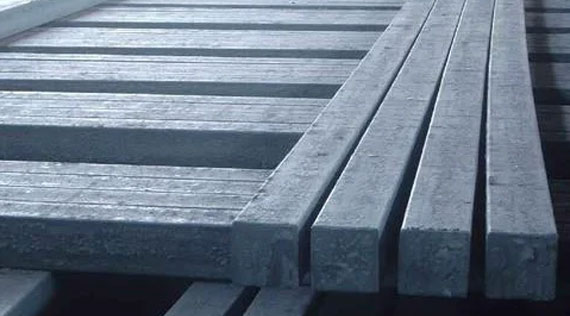
In most regional markets for square billets, prices rose slightly in April—by $10–15 per ton. The exception was the Persian Gulf countries, where prices fell by $8 to $516/t (CFR), after average prices had previously surged by $79 per ton in March due to logistical issues stemming from the war in the region and a shortage caused by the suspension of Iranian billet shipments.
At the beginning of the month, the rise in prices paused in most major markets, with the exception of Turkey. By mid-month, the situation had finally stabilized—without a clear trend. By the end of the month, market conditions improved amid growth in China and interest from Gulf countries.
In the Black Sea market for square billets (Black Sea FOB basis), average prices rose by $11 in April, reaching a high of $470/t—the highest level since the beginning of 2025. At the same time, the outlook for Russian billet exports remains under pressure from the strong ruble, which undermines the viability of exports. Foreign buyers are not willing to pay the prices that would allow Russian suppliers to secure contracts.
According to Turkish buyers, an acceptable price for Russian billets is $495–500/t on CFR Turkey terms, while Russian suppliers are asking for $504–505/t (CFR). Meanwhile, Chinese billets are offered on the Turkish market at $520/t (CFR) and higher.
The price of square billets on Turkey Ex-Works terms also rose on average in April—by $10/t, to $548/t, although at the beginning of the month, quotations reached $555/t. According to Kallanish, the Kardemir plant successfully held three tenders for the sale of billets. Following a $35/ton price increase in early April and stabilization a week later, the following prices were set at the April 22 auction: $535/ton (grade S235JR) and $550/ton (grade B420). These prices do not include 20% VAT.
Turkish consumers are required to purchase at least 25% of their steel on the local market when manufacturing finished products for export. However, despite stable demand, the Turkish domestic market currently faces a shortage of billets amid uncertainty related to the conflict in the Middle East, making imports a priority for Turkish buyers.
According to the Turkish Statistical Institute (TUIK), billet imports to Turkey surged by 46% MoM in February (in January: −17.6% MoM) to 430,000 tons. Russia was once again the largest supplier: 236,000 tons (+102.8% y/y).
Domestic billet production in Turkey in February fell by 4.9% y/y to 1.79 million tons. In the first two months of the year, output totaled 3.86 million tons (–0.1% y/y). Billet exports in February fell by 29% y/y to 20,200 tons. Nearly the entire volume of billet was shipped to Italy at an average price of $552/ton.
Throughout April, price offers rose, particularly from China ($470–475/t FOB). In Manila, prices reached $499–504/t on a CFR basis. However, buyers in the region (the Philippines, Indonesia) reacted coolly, considering the prices to be inflated and out of line with domestic demand. Buyers remained cautious due to uncertainty over oil prices, high freight costs, and the approaching rainy season.
Due to a shortage of Iranian billets, regional mills (such as Indonesia’s Dexin Steel) shifted capacity to the production of slabs and hot-rolled products, for which demand remains high, further reducing the availability of billets.
According to Kallanish, average prices for billet from Tangshan rose by $11/t in April to $442/t, following the lead of futures markets. Rolling mills continued to incur losses due to high billet prices amid weak demand for finished products. In the middle of the month, a number of rolling mills shut down due to environmental restrictions.
The conflict surrounding Iran continues to affect prices and the availability of raw materials throughout the Middle East. According to Kallanish, average prices in the Persian Gulf countries fell by $8 to $516/t (CFR) by the end of April, following a $79 jump in March caused by a billet shortage and logistical constraints in the region. Throughout the month, feedstock buyers repeatedly adopted a wait-and-see stance, anticipating a potential decline in freight rates and oil prices following reports of an imminent peace agreement and the reopening of the Strait of Hormuz.
According to Kallanish, there is a shortage of raw materials in the UAE and Oman markets, so mills are operating at 50% capacity. Buyers from the UAE are ordering billets from Indonesia at $485–490/t (FOB terms). Iranian billets are unlikely to return to the market in the near future. First, local steel mills have been severely damaged by missile attacks, and second, Iran has suspended exports of semi-finished products and flat steel until May 30, 2026.
Average prices for square billets (Ex-Works) in Italy rose by $15 in April compared to the end of March, reaching $607/t.
As previously reported, the National Bank of Ukraine (NBU) expects that by the end of 2026, average prices for steel billets will rise by 5.3% year-on-year to $489.2 per ton (on FOB Ukraine terms). Forecast prices for 2027 and 2028 will be $510.4/t (+4.3% y/y) and $518/t (+1.5% y/y) (FOB Ukraine).
Courtesy : https://gmk.center/en