
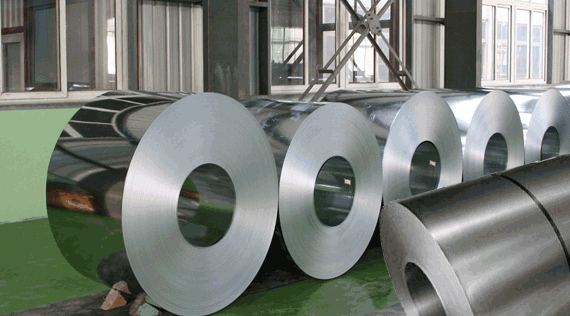
China’s market for hot-rolled coil (HRC) for export traded in a narrow range over December 20-26 as firm mill offers met weak buying interest.
At the start of last week, major mills had expected that the imposition of export licensing would limit the outflow of low-priced non-VAT hot coils into the market and therefore allow the makers to raise their offers to align with prevailing international HRC export prices without fear of being undercut, Mysteel Global notes.
Earlier this month, China's Ministry of Commerce and the China's General Administration of Customs had jointly announced that from this Thursday January 1, exports of some 400 carbon and stainless steel products including HRC would be managed through an export licensing system, as reported. The move will require exporters to secure licences based on formal export contracts and manufacturer-issued quality inspection certificates and theoretically close the gap that has allowed steel to leave the country without VAT being paid.
Despite the mills' firmer stance, transactions remained muted last week influenced by policy uncertainty, the year-end seasonal slowdown and Christmas holiday. As the week progressed, export offers stabilized at $465-480/t FOB China, with tradable levels around $460/t FOB, largely unchanged from the previous week.
Tighter Customs checks on cargoes where VAT has not been paid have disrupted shipments at China's major ports recently, market sources noted. In the absence of further policy details regarding the export licensing system, HRC export prices are expected to continue fluctuating within a narrow range, a Shanghai-based analyst predicted.
On December 26, Mysteel assessed the export price of SS400 3mm HRC at North China's Tianjin port unchanged on week at $445/t FOB.
Meanwhile, Indonesia's hot-rolled coil market remained largely stable last week, with SAE1006 3mm HRC offers to Vietnam holding at $480-485/t CFR. However, buyers largely remained on the sidelines, awaiting new price guidance from Vietnam's steelmaker Hoa Phat Group.
India saw domestic HRC prices gain over the past few weeks. However, the price rises were driven mainly by traders' restocking moves rather than in response to robust end-user demand, Mysteel Global understands, raising concerns over sustainability amid oversupply and uneven demand recovery. Export offers to Vietnam stayed at $480/t CFR, while buyers capped bids near $470/t, leaving the market at a standstill.
Europe's HRC market was largely inactive over Christmas, with limited spot activity and weak import interest amid holiday slowdowns and CBAM-related uncertainty.
Meanwhile, China's export price of SPCC 1.0mm cold-rolled coil (CRC) at Tianjin port rose by $3/t on week to $518/t FOB by December 26, according to Mysteel's assessment.